How Does BMT Work?
The first step of a bone marrow transplant (BMT) begins with your dog’s local oncologist. It’s crucial that clinical remission (CR) is achieved through the administration of chemotherapy. This is critical because a dog's disease burden—the number of cancer cells present—is as low as it will ever be with chemotherapy alone. Clinical remission, however, is not the same as molecular remission, since there are still a small number of cancer cells in your dog’s body. For all intents and purposes, it is not possible for a dog to achieve a molecular remission (ie, cured of its disease) using chemotherapy alone.
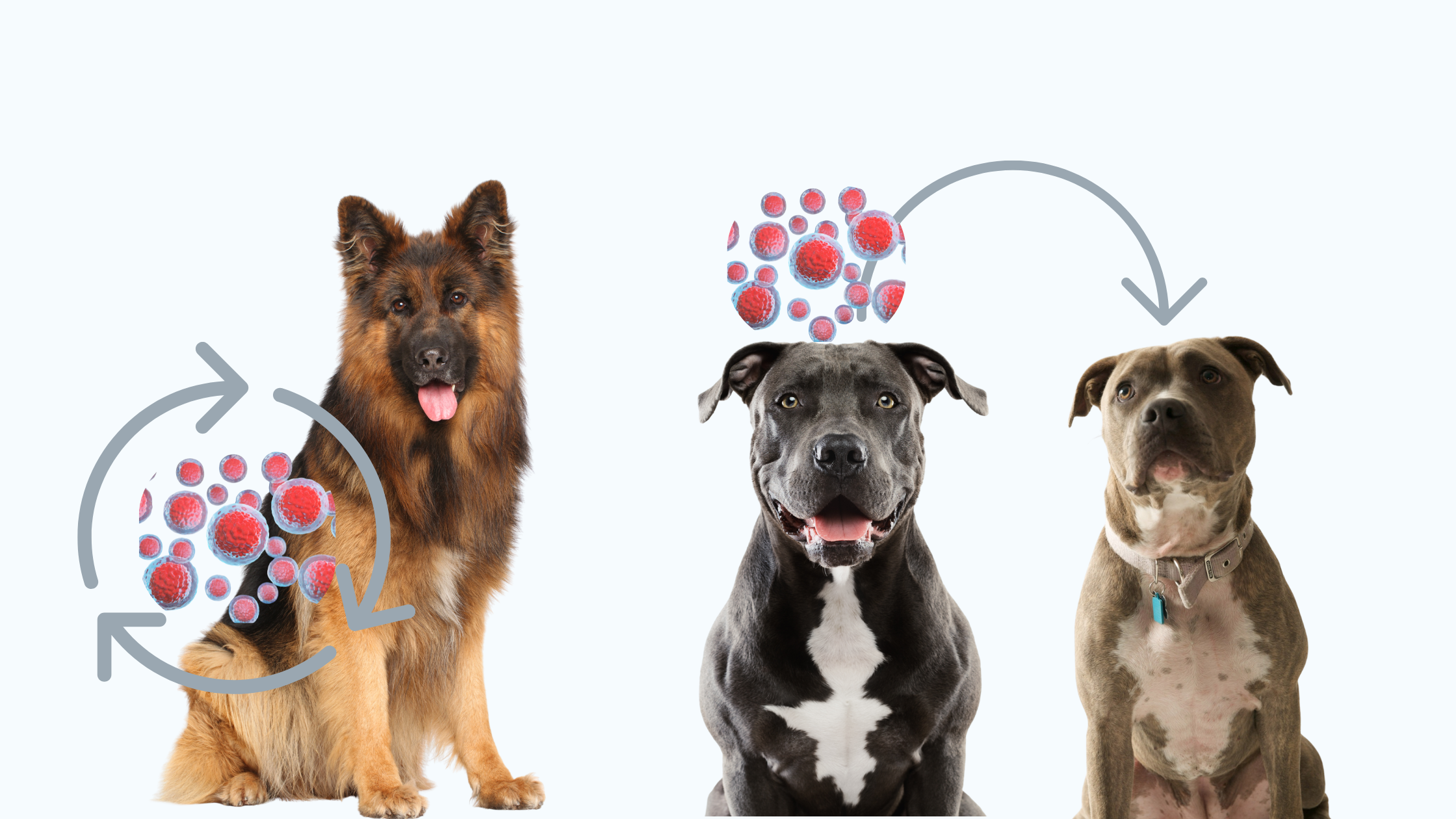
The goal of any BMT is to eliminate the remaining cancer cells hiding in the body, in the hopes of attaining a molecular remission and cure. This is done using total body irradiation (TBI), which kills the residual cancer cells still present in the body. TBI, however, also destroys the dog’s bone marrow. Since the bone marrow is a vital organ in the body and the dog cannot survive without it, hematopoietic stem cells (HSC) are collected prior to TBI and then infused into the dog after TBI to replenish this vital source of stem cells. These stem cells, which then repopulate the bone marrow, can come from either the dog themselves (autologous transplant), or from a matched donor dog (allogeneic transplant).
Autologous Transplant
An autologous BMT can be pursued when a matched donor dog cannot be located. Many dogs diagnosed with lymphoma and leukemia are not purebred, or are adopted from an animal shelter where blood relatives are nearly impossible to find. Autologous BMTs offer these dogs a much-deserved chance of survival.
Prior to arriving at CTAC, it is extremely important that dogs receiving an autologous BMT are in clinical remission. The goal is to collect HSC from the dog using a procedure called apheresis without collecting any cancer cells. Autologous BMTs rely solely on TBI alone to kill any remaining cancer cells in the body.
Immediately following TBI, the collected HSC are infused into the dog through an IV catheter. Once in the body, they travel through the bloodstream to the bone marrow that was damaged by the TBI. The stem cells then start producing white blood cells, platelets, and all the other blood cell lines needed for life. This is called engraftment. Engraftment in dogs who receive an autologous BMT tends to happen much quicker (five to seven days) than dogs who receive an allogeneic BMT, since their own HSCs are being reintroduced back into them.
Allogeneic Transplant
An allogeneic BMT uses HSC collected from a matched donor dog. Once the recipient dog’s TBI is completed, the previously collected donor dog HSCs are infused into the recipient dog. During this time, the recipient dog is started on an immunosuppressive medication that reduces the chance of graft rejection. After about ten to fourteen days, the newly populated bone marrow begins producing all the cell lines needed for life, leading to engraftment.
With the help of the donor dogs HSC, allogeneic BMT dogs have an additional benefit to TBI to kill all remaining cancer cells in the body. This is an immunotherapy component called graft versus lymphoma (See previous Graft versus Host Disease and Graft versus Tumor Blog Post). This very effective immunotherapy is responsible for the increased published cure rates of allogeneic BMTs when compared to autologous BMTs.
Offering Every Pet a Chance
Performing an allogeneic BMT is always preferred over an autologous BMT due to the added benefits of graft versus lymphoma. However, finding a matched donor can be difficult or, at times, impossible. This does not mean that hope is lost for these dogs. Having the option of performing an autologous BMT may still be your dog’s best opportunity to be cured and live a long and healthy life.